
 What transforms a place into a museum?
A collection of artworks?
An extraordinary building?
A distinguished history?
These are important, but they are not sufficient.
A museum becomes culturally significant when it does more than preserve objects. It preserves continuity—the continuous transmission of knowledge, imagination, craftsmanship, and creative inquiry from one generation to the next.
Throughout history, civilizations have created places where this continuity could be sustained: libraries, universities, observatories, workshops, monasteries, theaters, and museums. Although their forms differ, they share a common purpose: they create environments in which culture can endure, evolve, and be passed forward.
The story of the Museum of Modern Renaissance begins long before the museum itself.
The building was constructed in the early twentieth century as a church and served the community for decades as a place of gathering, reflection, and shared purpose. In 2002, a new chapter began. Rather than replacing the history of the building, the Museum of Modern Renaissance extended it, transforming a place once dedicated to spiritual reflection into one dedicated to artistic and cultural reflection.
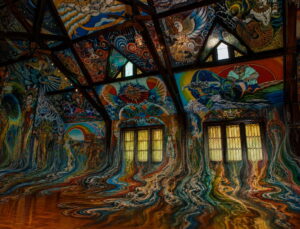
For more than two decades, Nicholas Shaplyko and Ekaterina Sorokina have worked within this space almost every day, gradually transforming its architecture into an immersive work of art. The museum did not begin with a completed collection. It began with a sustained creative process. The collection is the visible result of that process.
Today the museum functions simultaneously as a place of preservation and a place of creation.
New works continue to emerge.
Concerts, exhibitions, lectures, and cultural gatherings take place within the same environment in which the art itself is created. These events are not separate programs added to an institution; they arise naturally from its ongoing creative life. The museum does not exist to fill a calendar with events. Rather, its continuous artistic practice gives rise to exhibitions, performances, conversations, and collaborations that become part of its identity.
This continuity is essential.
Culture does not develop through isolated moments of inspiration. It grows through sustained practice, repeated encounters, and the gradual accumulation of human experience over time.
That is why the Museum of Modern Renaissance may be understood as a living museum.
Its collection includes paintings, sculptures, and architectural environments.
It also includes the continuing practice that produced them.
Its history is not closed.
Its collection is not complete.
Its cultural life remains active.
Visitors do not encounter only finished works of art; they enter an environment where artistic creation, dialogue, music, architecture, and public participation continue to shape one another.
The significance of such a place cannot be measured solely by the number of objects it contains.
It must also be measured by what it enables.
It enables artists to continue creating.
It enables ideas to be exchanged.
It enables cultural memory to remain active rather than static.
It enables future generations to inherit not only works of art, but also the conditions from which new works of art may emerge.
For more than one hundred years, this building has served as a place where people gather in search of meaning.
Since 2002, that search has continued through art.
That continuity is the foundation of the Museum of Modern Renaissance.
And that continuity is why this place is a museum.
Extraordinary
 Civilization occasionally creates places that cannot be explained by ordinary logic.
They are not born because they are practical.
They are not built because they are profitable.
They are not commissioned because a market has demanded them.
They appear because an idea enters human life with such force that comfort becomes secondary, certainty becomes unnecessary, and time itself becomes part of the material.
History knows such places.
In France, the Palais Idéal was built by Ferdinand Cheval, a rural postman who spent thirty-three years collecting stones during his daily route and carrying them home to build a palace no one had asked for. At first, it must have seemed impossible to explain: a postman, stones, night after night, year after year. Yet what began outside the logic of profession, wealth, or status became one of the world’s most unforgettable visionary environments.
In Florida, Coral Castle was created over decades by Edward Leedskalnin, who worked largely alone, carving and moving enormous blocks of limestone into a mysterious architectural landscape. No institution ordered it. No practical purpose justified it. Yet it continues to draw visitors because it carries the unmistakable mark of a human being possessed by an idea larger than ordinary life.
In Los Angeles, the Watts Towers were built by Simon Rodia over more than thirty years from steel, concrete, broken glass, ceramics, shells, and discarded fragments of the modern world. What others might have thrown away became, through decades of devotion, a cultural landmark. The towers survived doubt, neglect, and the threat of demolition because the force that created them proved stronger than the categories that first failed to understand them.
These places are completely different.
Different materials.
Different countries.
Different destinies.
Yet they share one hidden law:
an idea appears,
a life bends around it,
and eventually the idea becomes a place.
The Museum of Modern Renaissance belongs to this question.
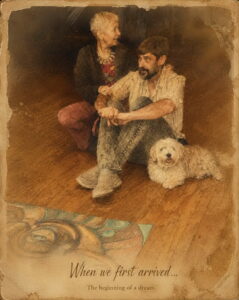
In 1994, Nicholas Shaplyko and Ekaterina Sorokina arrived in the United States under the classification Extraordinary Ability as Artists. They arrived with thirty dollars, a box of paints, and their dog.
Not a fortune.
Not a foundation.
Not a plan for comfort.
A box of paints.
A living creature they refused to abandon.
And a conviction that art was not decoration, but destiny.
For years, nearly every available dollar went toward paint, canvas, tools, and the slow transformation of life into work. There were times when comfort disappeared, when ordinary security seemed unreachable, when the choice was painfully simple: eat better, live easier, or continue creating.
They continued creating.
This is not sentimentality.
It is evidence.
Because extraordinary places are not usually born from abundance. They are born from necessity of spirit. They are created when people give not only their talent, but their years, their strength, their resources, their health, their privacy, and sometimes the simplest comforts of daily life to something that does not yet have a name.
The building that now holds the Museum of Modern Renaissance was first built in 1910 as a church. For more than a century, it has been a place where people gathered in search of meaning.
In 2002, that search entered a new form.
The church did not simply become a building with paintings inside.
It became a living artistic organism.
Walls, ceilings, rooms, sculptures, concerts, visitors, conversations, and daily work gradually fused into one continuous environment. The museum was not installed. It was not purchased. It was not assembled as a cultural product.
It was painted into existence.
For more than a quarter of a century, the work has continued.
One wall after another.
One image after another.
One sculpture after another.
One event after another.
One act of faith after another.
What began with thirty dollars and a box of paints became a place people can enter, stand inside, and experience with their own senses.
That is why this museum is not only an institution.
It is a discovery.
A discovery not hidden in some distant country or inaccessible private archive, but existing here, now, within reach.
A place where visitors can see what happens when an idea survives poverty, uncertainty, time, exhaustion, and disbelief.
Is the Museum of Modern Renaissance another member of that rare family of cultural places that history slowly learns how to name?
Is it one of those environments that first appear impossible, then strange, then unforgettable, and finally necessary?
Will future generations understand it more clearly than the present does?
These questions remain open.
But the place already exists.
It can be visited.
It can be walked through.
It can be heard in music.
It can be seen in paint.
It can be felt in the silence between images.
And perhaps that is where every true discovery begins:
not in explanation,
but in encounter.
Civilization does not preserve every building.
It does not remember every ambition.
But sometimes it recognizes a place where a human life became inseparable from an idea.
The Museum of Modern Renaissance asks to be seen in that light.
Not as a claim.
As an invitation.
Come and decide for yourself what kind of place this is.
 Birth place of Yoga on American soil.
The building at 115 College Avenue in Somerville once housed the West Somerville Unitarian Church and is now home to the “Museum of Modern Renaissance”.
Here in 1920 Yoga had been introduced first time on American soil.
We believe, that this unique cultural site is an appropriate candidate for a National Historic Landmark designation.
The building is historically significant as the site of Paramahansa Yogananda’s first talk introducing the philosophy of Yoga in America.
Paramahansa Yogananda (1893–1952) is credited with bringing the ancient spiritual teachings of India to Western world and is widely revered as one of the preeminent spiritual figures of our time. His “Autobiography of a Yogi” is regarded worldwide as a classic of religious literature and has been named one of the 100 best spiritual books of the 20th Century. The book has been translated into 18 languages and still appears on bestseller lists today, after more than 50 consecutive years in print.
Paramahansa Yogananda first came to the United States in 1920 to speak at an interfaith congress of religious leaders. On October 6, 1920 he delivered a speech before the International Congress of Religious Liberals, an account of which was published by the American Unitarian Association in a book titled “New Pilgrimages of the Spirit.”
Shortly after the congress, Yogananda was invited to the West Somerville Unitarian Church located at 115 College Ave. He recalls: “After the Congress was over, I began to formulate plans for starting a center. Then one day Mr. Foster said, “Come to my church next Sunday and I will talk to you there.”
I felt that it was a true sign, that at last the long-awaited word from God had come.”
It was here that he gave this first public educational talk. It was also here that he met Alice Hasey who later became known as Sister Yogmata. He wrote: “I heard an inner voice say: “She is one who will start the center”.
Indeed, Sister Yogmata, his first disciple in the US, helped to finance the first Yoga Center, which they built in Waltham. In 1925, Yogananda established his headquarters in Los Angeles.
During the 1920s, Yogananda traveled extensively throughout the United States and gave lectures. Following the enthusiastic response of the American public, Yogananda founded the Self Realization Fellowship, an international society. Today, there are nearly 500 Self Realization centers throughout the world.
But his spiritual quest had begun here at 115 College Ave in Somerville, MA.
Now you can see here the living manifest of Self Realization – the “Museum of Modern Renaissance”.
We are two artists, Nicholas Shaplyko and Ekaterina Sorokina, who now preserve this place of historic importance and who express our Self Realization through art, having created the “Museum of Modern Renaissance” which is dedicated to helping people of all races and creeds to realize and express more fully in their lives the beauty, nobility, and divinity of the human spirit.